Dasyphractus vellerosus
(J. E. Gray, 1865)
Screaming Hairy Armadillo
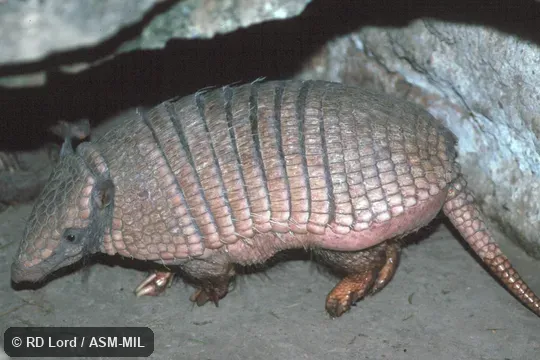
Distribution :
Bolivia, NE Chile, Paraguay, and NW Argentina south into Buenos Aires province.
Image courtesy of the ASM Mammal Images Library · MIL ID: 3592
Taxonomy
| Subclass | : Theria |
| Infraclass | : Placentalia |
| Magnorder | : Atlantogenata |
| Superorder | : Xenarthra |
| Order | : Cingulata |
| Suborder | : Eucingulata |
| Superfamily | : Chlamyphoroidea |
| Family | : Euphractidae |
| Subfamily | : Euphractinae |
| Genus | : Dasyphractus |
Species status
Authority citation
Gray, J.E. 1865-10. Revision of the genera and species of entomophagous Edentata, founded on the examination of the specimens in the British Museum. Proceedings of the Zoological Society of London 1865(2):359-386.
Authority publication link
Original name as described
Dasypus vellerosus
Other common names
Lesser Hairy Armadillo · Small Hairy Armadillo · Andean Hairy Armadillo
Type material
BMNH:Mamm:1847.11.22.20
Type kind
holotype
Type specimen URI
Type locality
"Santa Cruz de la Sierra, " Santa Cruz, Bolivia.
Biogeographic realm
Neotropic
Country distribution
Argentina · Bolivia · Chile · Paraguay · Peru?
Taxonomy notes
includes nationi; moved from Chaetophractus to Dasyphractus based on recently published molecular and morphological data; moved from Dasypodidae to Chlamyphoridae, and more recently from Chlamyphoridae to Euphractidae
Taxonomy notes citation
Abba, A.M., Cassini, G.H., Valverde, G., Tilak, M.-K., Vizcaíno, S.F., Superina, M. and Delsuc, F. 2015. Systematics of hairy armadillos and the taxonomic status of the Andean hairy armadillo (Chaetophractus nationi). Journal of Mammalogy 96(4):673-689. doi:10.1093/jmammal/gyv082 · Gibb, G.C., Condamine, F.L., Kuch, M., Enk, J., Moraes-Barros, N., Superina, M., Poinar, H.N. and Delsuc, F. 2016. Shotgun mitogenomics provides a reference phylogenetic framework and timescale for living xenarthrans. Molecular Biology and Evolution 33(3):621-642. doi:10.1093/molbev/msv250 · Casali, D. de M., Castro, M.C., Ciancio, M.R., Gaudin, T.J., Bramblett, J.L., Boscaini, A., Perini, F.A. and Langer, M.C. 2026. Unravelling the phylogeny of armadillos and their kin (Mammalia, Xenarthra, Cingulata) combining morphological, molecular, and stratigraphic data. Cladistics (in press). doi:10.1111/cla.70048
IUCN Red List status
Not Evaluated
Species Permalink
Country distribution map
The map below provides a general overview. Most species inhabit only specific regions within countries. Known distribution is shown in green and predicted distribution is in yellow.Hover over the highlighted regions to see the country name.
Names and synonyms
Present and past (if available) associated names to the species. Click on a name to view its details.
Total: 17 names and synonyms.
7 more names and synonyms available — use the desktop version to see them all.
Show 7 more names and synonyms
Please send any edits, corrections, or unfilled data (including full citations) to mammaldiversity [at] gmail [dot] com.