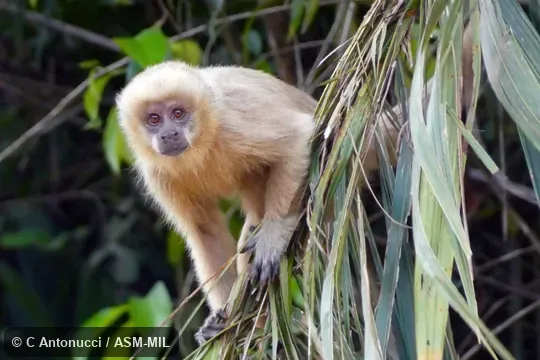
Sapajus flavius
(von Schreber, 1799)
Blond Capuchin
Distribution :
Coastal NE Brazil
Image courtesy of the ASM Mammal Images Library · MIL ID: 6422
Taxonomy
| Subclass | : Theria |
| Infraclass | : Placentalia |
| Magnorder | : Boreoeutheria |
| Superorder | : Euarchontoglires |
| Order | : Primates |
| Suborder | : Haplorhini |
| Infraorder | : Simiiformes |
| Parvorder | : Platyrrhini |
| Family | : Cebidae |
| Subfamily | : Cebinae |
| Genus | : Sapajus |
Species status
Authority citation
Schreber, J.C.D. von. 1799. pl. 31B. P. pl. 31B in Schreber, J.C.D. von. 1774-1855. Die Säugthiere in Abbildungen nach der Natur, mit Beschreibungen. Walther, Erlangen.
Authority publication link
Original name as described
Simia flavia
Other common names
Blonde Capuchin · Marcgrave's Capuchin
Type material
UFPB 5091
Type kind
neotype
Type locality
Côrrego do Inferno, Usina Maravilha, municipality of Goiana, Pernambuco, Brazil, 7° 28' 35.95" S, 34° 59' 4.85" W.
Biogeographic realm
Neotropic
Country distribution
Brazil
Taxonomy notes
moved from Cebus to Sapajus, although this arrangement is relatively tentative, as a number of sources still consider Sapajus as a subgenus of Cebus; oldest name available for the species recently described as queirozi; the year is often sited as 1774, however, the actual date for the authority of this species is 1799 according to Zijlstra, 2020
Taxonomy notes citation
Mendes Pontes, A.R., Malta, A. and Asfora, P.H. 2006. A new species of capuchin monkey, genus Cebus Erxleben (Cebidae, Primates): found at the very brink of extinction in the Pernambuco Endemism Centre. Zootaxa 1200(1):1-12. doi:10.11646/zootaxa.1200.1.1 · Oliveira, M.M. de and Langguth, A.R. 2006. Rediscovery of Marcgrave's capuchin monkey and designation of a neotype for Simia flavia Schreber, 1774 (Primates, Cebidae). Boletim do Museu Nacional (Zoologia)523:1-16. a#4750 · Lynch Alfaro, J.W., Silva Júnior, J. de S. e and Rylands, A.B. 2012. How different are robust and gracile capuchin monkeys? An argument for the use of Sapajus and Cebus. American Journal of Primatology 74(4):273-286. doi:10.1002/ajp.22007 · Gutiérrez, E.E. and Marinho-Filho, J. 2017. The mammalian faunas endemic to the Cerrado and the Caatinga. ZooKeys 644:105-157. doi:10.3897/zookeys.644.10827 · Teta, P. 2019. The usage of subgenera in mammalian taxonomy. Mammalia 83(3):209-211. doi:10.1515/mammalia-2018-0059 · Zijlstra, J.S. 2020. The nomenclature of the blond capuchin, Cebus flavius (Schreber, 1799) (Mammalia, Primates, Cebidae). Zootaxa 4820(2):398-400. doi:10.11646/zootaxa.4820.2.14 · Martins, A.B., Valença-Montenegro, M.M., Lima, M.G.M., Lynch, J.W., Svoboda, W.K., Silva-Júnior, J.D.S.E., Röhe, F., Boubli, J.P. and Fiore, A.D. 2023. A new assessment of robust capuchin monkey (Sapajus) evolutionary history using genome-wide SNP marker data and a Bayesian approach to species delimitation. Genes 14(5):970. doi:10.3390/genes14050970
IUCN Red List status
Endangered
Species Permalink
Country distribution map
The map below provides a general overview. Most species inhabit only specific regions within countries. Hover over the highlighted regions to see the country name.
Names and synonyms
Present and past (if available) associated names to the species. Click on a name to view its details.
Total: 9 names and synonyms.
Please send any edits, corrections, or unfilled data (including full citations) to mammaldiversity [at] gmail [dot] com.