Arvicanthis niloticus
(É. Geoffroy Saint-Hilaire, 1803)
African Grass Rat
Distribution :
Grassland and bush of Sahelian and northern Sudanian savannas, steppe, and semidesert in subsaharan N Africa, primarily in anthropogenic habitats, from Senegal (north of Gambia River), S Mauritania eastward through Mali, Burkina Faso, C and S Niger , and C and S Chad to Sudan and western half and EC portion of Ethiopia; north along the Nile Valley through Egypt; south through NE Dem. Rep. Congo, Uganda, S Burundi, and W Tanzania into E Zamibia, where the population is isolated from the nearest one in SW Tanzania. There is a record from N Malawi (1 skull only, living animals never found, and the species also occurs in SW Arabian Peninsula (SW Yemen and W Oman).
Notes :
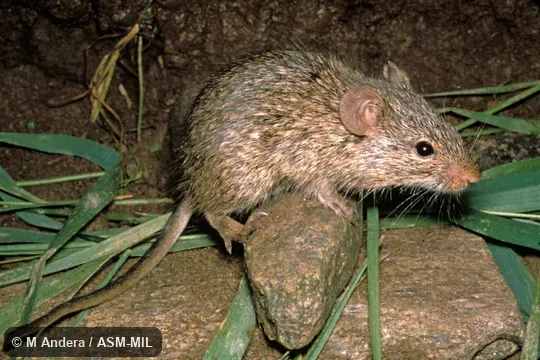
The species identification is uncertain. This individual may represent a different taxon.
Image courtesy of the ASM Mammal Images Library · MIL ID: 1390
Taxonomy
| Subclass | : Theria |
| Infraclass | : Placentalia |
| Magnorder | : Boreoeutheria |
| Superorder | : Euarchontoglires |
| Order | : Rodentia |
| Suborder | : Supramyomorpha |
| Infraorder | : Myomorphi |
| Superfamily | : Muroidea |
| Family | : Muridae |
| Subfamily | : Murinae |
| Tribe | : Arvicanthini |
| Genus | : Arvicanthis |
Species status
Authority citation
Geoffroy Saint-Hilaire, É. 1803. Catalogue des Mammifères du Muséum national d'Histoire naturelle. Privately published, Paris, 272 pp.
Authority publication link
Original name as described
Lemmus niloticus
Other common names
African Arvicanthis · Nile Grass Rat · Unstriped Grass Rat
Type material
MNHN:type:350 (= MNHN "1110")
Type kind
holotype
Type locality
Egypt.
Biogeographic realm
Afrotropic
Country distribution
Algeria · Burkina Faso · Burundi · Cameroon · Central African Republic · Chad · Democratic Republic of the Congo · Egypt · Eritrea · Ethiopia · Gambia · Kenya · Mali · Mauritania · Niger · Nigeria · Rwanda · Senegal · South Sudan · Sudan · Tanzania · Uganda · Yemen · Zambia · Benin? · Cote d'Ivoire? · Ghana? · Malawi? · Oman? · Saudi Arabia? · Togo?
Taxonomy notes
previously included A. mearnsi and A. raffertyi and still represents a species complex as currently defined
Taxonomy notes citation
Bryja, J., Colangelo, P., Lavrenchenko, L.A., Meheretu, Y., Šumbera, R., Bryjová, A., Verheyen, E., Leirs, H. and Castiglia, R. 2019. Diversity and evolution of African Grass Rats (Muridae: Arvicanthis)—From radiation in East Africa to repeated colonization of northwestern and southeastern savannas. Journal of Zoological Systematics and Evolutionary Research 57(4):970-988. doi:10.1111/jzs.12290
IUCN Red List status
Least Concern
Species Permalink
Country distribution map
The map below provides a general overview. Most species inhabit only specific regions within countries. Known distribution is shown in green and predicted distribution is in yellow.Hover over the highlighted regions to see the country name.
Names and synonyms
Present and past (if available) associated names to the species. Click on a name to view its details.
Total: 57 names and synonyms.
47 more names and synonyms available — use the desktop version to see them all.
Show 47 more names and synonyms
Please send any edits, corrections, or unfilled data (including full citations) to mammaldiversity [at] gmail [dot] com.